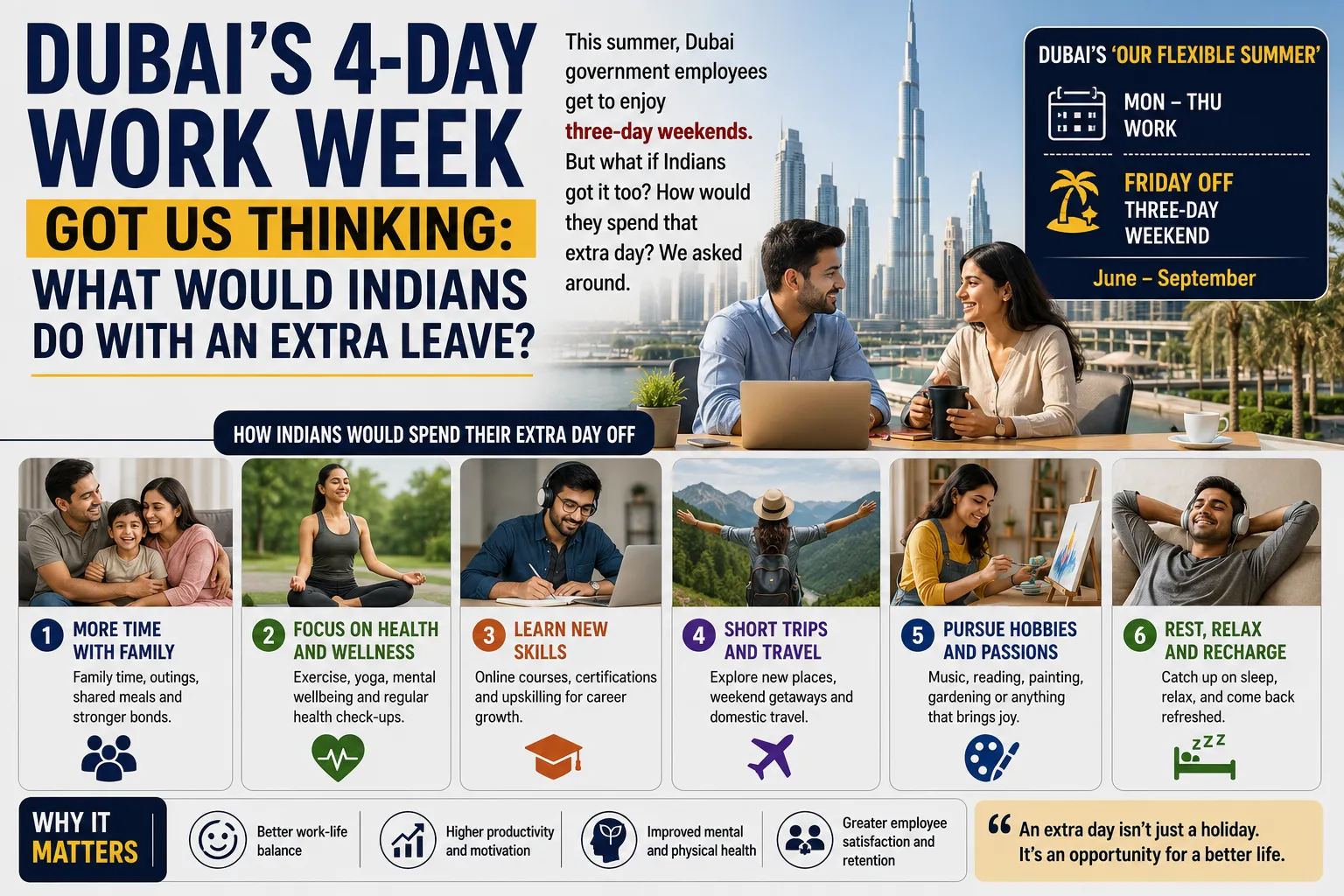
The idea of a four-day work week has long been a topic of discussion in workplaces around the world. As companies and governments increasingly explore flexible work arrangements, the focus has shifted from simply reducing working hours to improving employee wellbeing, productivity, and work-life balance. This conversation gained fresh momentum after Dubai reintroduced its "Our Flexible Summer" initiative for government employees, allowing many of them to enjoy three-day weekends during the summer months.
The initiative has sparked curiosity beyond the United Arab Emirates, especially in countries like India, where long working hours, busy commutes, and demanding schedules often leave little time for personal life. It naturally raises an interesting question: if Indian employees were given one additional day off every week, how would they use it?
Would they travel more, spend quality time with family, learn new skills, focus on health, or simply catch up on much-needed rest? The answers reveal changing priorities in today's workforce and highlight why work-life balance has become more important than ever.
Dubai's Flexible Summer Initiative
Dubai's government has once again introduced its seasonal "Our Flexible Summer" initiative for public sector employees. Running from late June until September, the programme allows participating government departments to adopt one of two flexible work models based on operational requirements.
Under one arrangement, employees work four full days from Monday to Thursday and receive Friday off, effectively creating a three-day weekend. Another option provides shorter working hours throughout the week while maintaining essential government services. The initiative is designed to promote employee wellbeing without compromising productivity or public service delivery. Previous editions of the programme reported positive outcomes, including higher employee satisfaction and improved workplace efficiency.
Why the Four-Day Work Week Is Gaining Attention
The traditional five-day work schedule has remained largely unchanged for decades. However, modern workplaces are evolving rapidly.
Remote work, hybrid models, digital collaboration tools, and increasing awareness of employee wellbeing have encouraged organisations to rethink conventional working patterns.
Several countries and private companies have experimented with four-day work weeks to examine whether fewer working days can produce equal or even better productivity.
Many pilot programmes have found improvements in employee morale, reduced burnout, and better work-life balance, although results vary depending on the industry and nature of the work.
The discussion is gradually shifting from "working more hours" to "working more effectively."
What Would Indians Do With an Extra Day Off?
For many Indian professionals, an additional weekly holiday would represent more than simply extending the weekend.
Given the long commuting hours in metropolitan cities, demanding work schedules, and increasing digital connectivity, many employees feel they have limited personal time.
An extra day could become an opportunity to restore balance across different aspects of life.
Surveys and public discussions suggest that Indians would likely use the additional time in several meaningful ways rather than viewing it merely as another holiday.
Spending More Time With Family
One of the most common aspirations among working professionals is spending more quality time with family.
Busy schedules often leave parents with limited opportunities to engage with their children during weekdays.
Many professionals also struggle to visit elderly parents or extended family regularly.
An additional weekly holiday could provide valuable time for family gatherings, outings, shared meals, or simply meaningful conversations without workplace interruptions.
In a society where family relationships remain central to everyday life, this benefit could be particularly significant.
Prioritising Physical and Mental Health
Health frequently becomes a lower priority when work schedules become demanding.
Many employees postpone exercise, medical check-ups, adequate sleep, or relaxation because of professional commitments.
An extra day off could encourage healthier lifestyles through regular fitness routines, outdoor activities, yoga, meditation, or preventive healthcare.
Mental wellbeing would also likely improve.
Reduced stress, lower burnout, and better recovery time between workweeks can contribute positively to overall productivity and long-term health.
Learning New Skills
India's rapidly changing job market increasingly rewards continuous learning.
Many professionals want to improve their technical skills, study artificial intelligence, data analytics, digital marketing, finance, foreign languages, or management but struggle to find time alongside full-time employment.
A four-day work week could provide dedicated time for professional development without requiring employees to sacrifice personal weekends.
Lifelong learning has become an essential part of career growth in today's knowledge economy.
Short Weekend Travel
India's diverse geography makes short trips especially attractive.
With an extra day available each week, many professionals could plan weekend getaways to nearby hill stations, beaches, wildlife parks, historical cities, or cultural destinations.
Domestic tourism could potentially benefit as travelers become more willing to explore shorter vacations throughout the year instead of relying solely on annual leave.
The hospitality industry, local businesses, and regional tourism economies may also experience increased activity.
Pursuing Personal Hobbies
Many people postpone hobbies because work consumes most of their available time.
Reading, painting, photography, music, gardening, cooking, writing, cycling, sports, and volunteering often receive little attention during busy workweeks.
An additional day could allow individuals to reconnect with personal interests that contribute to creativity, happiness, and emotional wellbeing.
These activities may not directly increase income, but they often improve overall life satisfaction.
Supporting Better Work-Life Balance
Work-life balance has become one of the most important factors influencing employee satisfaction.
Employees increasingly value flexibility alongside salary.
A healthier balance between professional responsibilities and personal life often leads to stronger motivation, lower absenteeism, and improved retention.
Companies worldwide are recognizing that employee wellbeing is closely connected to organisational performance.
Rather than measuring productivity solely through working hours, many employers are now focusing on outcomes and efficiency.
Could a Four-Day Week Work in India?
Implementing a four-day work week across India would present both opportunities and challenges.
Industries such as information technology, consulting, design, research, and certain corporate services may find flexible scheduling easier to adopt.
However, manufacturing, healthcare, transportation, retail, hospitality, emergency services, and public administration often require continuous operations.
Any transition would therefore require careful planning rather than a universal approach.
Different sectors may need different solutions depending on operational requirements.
Productivity Versus Working Hours
One common concern is whether reducing working days would reduce productivity.
However, several international experiments suggest that productivity depends more on work quality than total hours spent in the office.
When employees are well-rested, motivated, and focused, they often accomplish more within shorter working periods.
Reducing unnecessary meetings, improving digital workflows, and encouraging efficient time management may offset fewer working days.
Nevertheless, successful implementation depends on organisational culture and effective management.
Employers Also Have Considerations
Businesses must balance employee wellbeing with customer expectations, operational continuity, and financial performance.
A shorter work week may require revised staffing schedules, automation, flexible teams, or staggered shifts.
Some organisations may experience higher short-term implementation costs before realising long-term benefits.
Therefore, many experts recommend gradual pilot programmes before introducing permanent changes across entire organisations.
The Future of Flexible Work
The conversation surrounding flexible work continues to evolve.
Hybrid work, remote collaboration, compressed workweeks, flexible scheduling, and outcome-based performance evaluation are becoming increasingly common across many industries.
Rather than asking whether every organisation should adopt a four-day week, companies are increasingly asking which flexible model best suits their workforce.
Technology continues enabling new ways of working that were difficult to imagine only a decade ago.
Conclusion
Dubai's renewed summer four-day work week has reignited an important global conversation about the future of work. By giving many government employees longer weekends through flexible scheduling, the initiative highlights how organisations can explore innovative ways to improve employee wellbeing while maintaining productivity. For Indian professionals, the idea of an additional weekly day off resonates strongly because it promises something many people feel they lack—time. Whether spent with family, pursuing hobbies, travelling, improving health, or learning new skills, that extra day could significantly enhance quality of life.
While a nationwide four-day work week may not be practical for every sector in India, the discussion itself reflects changing expectations in the modern workplace. Employees increasingly value flexibility, balance, and wellbeing alongside financial rewards. As businesses continue adapting to new ways of working, the future is likely to focus less on the number of hours spent at work and more on the value created during those hours. The growing interest in flexible work models suggests that the traditional workweek may continue evolving to better meet the needs of both employees and employers.
islamicduahub islamicduahub islamicduahub islamicduahub islamicduahub islamicduahub islamicduahub islamicduahub islamicduahub islamicduahub islamicduahub islamicduahub islamicduahub islamicduahub islamicduahub islamicduahub islamicduahub islamicduahub islamicduahub islamicduahub islamicduahub islamicduahub islamicduahub islamicduahub islamicduahub islamicduahub islamicduahub islamicduahub islamicduahub islamicduahub islamicduahub islamicduahub islamicduahub islamicduahub islamicduahub islamicduahub islamicduahub islamicduahub islamicduahub islamicduahub islamicduahub islamicduahub islamicduahub islamicduahub islamicduahub islamicduahub islamicduahub islamicduahub islamicduahub islamicduahub islamicduahub islamicduahub islamicduahub islamicduahub islamicduahub islamicduahub islamicduahub islamicduahub islamicduahub islamicduahub islamicduahub islamicduahub islamicduahub islamicduahub islamicduahub islamicduahub islamicduahub islamicduahub islamicduahub islamicduahub islamicduahub islamicduahub islamicduahub islamicduahub islamicduahub islamicduahub islamicduahub islamicduahub islamicduahub islamicduahub islamicduahub islamicduahub islamicduahub islamicduahub islamicduahub islamicduahub islamicduahub islamicduahub islamicduahub islamicduahub islamicduahub islamicduahub islamicduahub islamicduahub islamicduahub islamicduahub islamicduahub islamicduahub islamicduahub islamicduahub islamicduahub islamicduahub islamicduahub islamicduahub islamicduahub islamicduahub islamicduahub islamicduahub islamicduahub islamicduahub islamicduahub islamicduahub islamicduahub islamicduahub islamicduahub islamicduahub islamicduahub islamicduahub islamicduahub islamicduahub islamicduahub islamicduahub islamicduahub islamicduahub islamicduahub islamicduahub islamicduahub islamicduahub islamicduahub islamicduahub islamicduahub islamicduahub islamicduahub islamicduahub islamicduahub islamicduahub islamicduahub islamicduahub islamicduahub islamicduahub islamicduahub islamicduahub islamicduahub islamicduahub islamicduahub islamicduahub islamicduahub islamicduahub islamicduahub islamicduahub islamicduahub islamicduahub islamicduahub islamicduahub islamicduahub islamicduahub islamicduahub islamicduahub islamicduahub islamicduahub islamicduahub islamicduahub islamicduahub islamicduahub islamicduahub islamicduahub islamicduahub