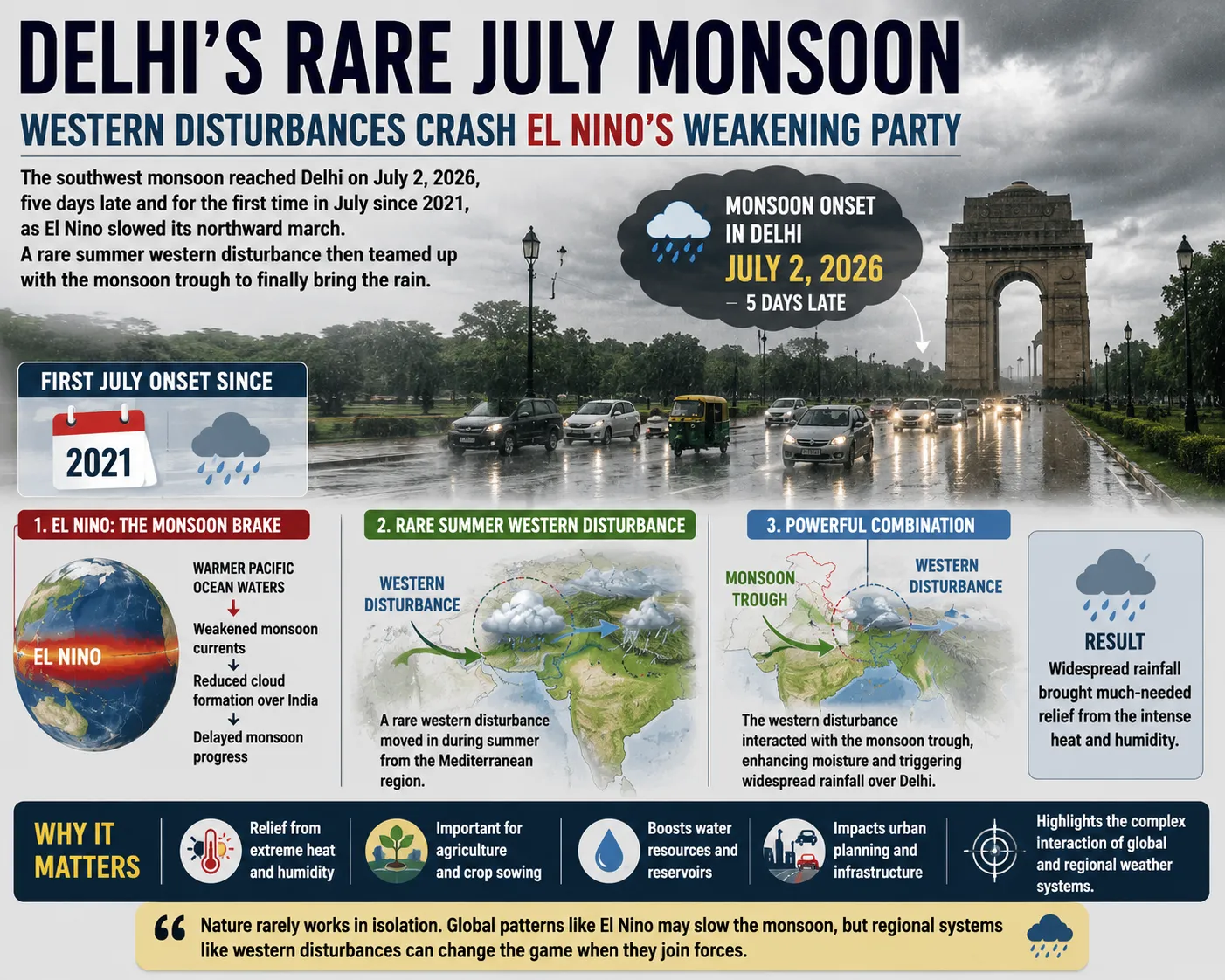
After weeks of scorching temperatures, oppressive humidity, and anxious anticipation, Delhi finally welcomed the southwest monsoon on July 2, 2026. The arrival came five days later than the city's normal onset date of June 27, making it the first July monsoon arrival in the national capital since 2021. While delayed monsoons are not unprecedented, the reasons behind this year's late arrival reveal a fascinating interaction between global climate patterns and regional weather systems.
Meteorologists point to two major atmospheric forces that shaped Delhi's unusual weather. On one side was El Niño, the Pacific Ocean climate phenomenon known for weakening the Indian summer monsoon. On the other was a rare summer western disturbance that interacted with the monsoon trough and ultimately helped trigger widespread rainfall across Delhi and nearby regions. The event highlights the complexity of India's monsoon system and demonstrates how weather thousands of kilometres away can influence rainfall over the subcontinent.
A Delayed but Welcome Arrival
The India Meteorological Department officially declared the onset of the southwest monsoon over Delhi on July 2, around five days later than the city's long-term average onset date. It was also the first time since 2021 that Delhi experienced a July onset of the monsoon.
The delayed rains followed several weeks of intense heat, with temperatures frequently crossing 42°C in parts of the National Capital Region. High humidity without rainfall created uncomfortable weather conditions and increased public anticipation for the arrival of the monsoon.
When widespread showers finally arrived, they brought immediate relief from the prolonged heatwave and marked the beginning of the rainy season across the capital.
Understanding the Southwest Monsoon
The southwest monsoon is one of the world's most important seasonal weather systems. It typically develops as land over the Indian subcontinent heats up during summer, creating a low-pressure area that draws moisture-laden winds from the Arabian Sea and the Bay of Bengal.
These winds gradually advance across India between June and July, delivering nearly 70 percent of the country's annual rainfall.
The timing of the monsoon is critical because it influences agriculture, water availability, hydroelectric power generation, and overall economic activity.
Even relatively short delays can affect crop sowing schedules and reservoir levels.
The Role of El Niño
One of the primary reasons behind the delayed advance this year was the influence of El Niño.
El Niño is a naturally occurring climate pattern characterized by unusually warm sea surface temperatures in the central and eastern equatorial Pacific Ocean. Although it develops far from India, it influences atmospheric circulation across the globe.
During El Niño years, rising air tends to shift eastward over the Pacific Ocean. This alters tropical circulation patterns and often suppresses cloud formation over the Indian region, weakening the southwest monsoon.
The result is frequently reduced rainfall, delayed monsoon progression, and hotter-than-normal conditions across many parts of India.
While El Niño does not guarantee drought every year, it significantly increases the probability of weaker monsoon performance.
Why Western Disturbances Matter
While El Niño slowed the monsoon's advance, another weather system eventually helped reverse the situation.
Western disturbances are low-pressure systems that originate over the Mediterranean region and travel eastward across West Asia before reaching northern India.
They are best known for bringing winter rain and snowfall to the Himalayan region.
However, on rare occasions, western disturbances also occur during summer.
This year, one such disturbance interacted with the advancing monsoon circulation over northwestern India.
The combined effect enhanced atmospheric instability, encouraged cloud formation, and produced widespread rainfall across Delhi and neighbouring states.
This interaction played a crucial role in finally pushing the monsoon into the capital.
How the Two Systems Worked Together
The arrival of the monsoon was not the result of one weather event alone.
Instead, meteorologists observed a complex interaction between the delayed monsoon circulation and the incoming western disturbance.
The disturbance strengthened upward motion in the atmosphere while the monsoon supplied abundant moisture.
Together, these systems generated conditions favourable for sustained rainfall rather than isolated thunderstorms.
This rare atmospheric partnership effectively overcame some of the suppressing influence created by El Niño.
It demonstrates that regional weather systems can sometimes temporarily offset broader climate patterns.
Why Delhi's Monsoon Timing Is Important
The arrival date of the monsoon is closely monitored because it influences multiple sectors.
Agriculture depends heavily on timely rainfall for sowing important crops such as rice, maize, cotton, and pulses.
Urban planners also watch the monsoon carefully because heavy rainfall affects drainage systems, transportation, and flood preparedness.
For residents, the monsoon provides welcome relief from extreme summer temperatures while also improving air quality by reducing dust and suspended pollutants.
Although the delayed onset raised concerns, the eventual arrival offered much-needed relief after a particularly dry and hot June.
Climate Variability and Changing Weather Patterns
Scientists increasingly emphasize that climate variability is making weather patterns more unpredictable.
Natural climate drivers such as El Niño continue to influence rainfall, but long-term climate change may also affect the frequency and intensity of extreme weather events.
Several recent years have witnessed unusual combinations of heatwaves, delayed rainfall, intense cloudbursts, and localized flooding across different parts of India.
While no single weather event can be attributed solely to climate change, researchers continue studying how rising global temperatures interact with natural climate cycles.
Understanding these relationships remains essential for improving seasonal forecasts.
Challenges of Forecasting the Monsoon
Forecasting the Indian monsoon remains one of meteorology's greatest scientific challenges.
Numerous interacting factors influence rainfall, including sea surface temperatures, atmospheric pressure systems, snow cover over the Himalayas, the Indian Ocean Dipole, El Niño, La Niña, and western disturbances.
Small changes in one component can significantly affect rainfall distribution across different regions.
Modern weather models have improved substantially through advances in satellite observations, ocean monitoring, and computer simulations.
Nevertheless, predicting the exact timing and intensity of rainfall continues to involve considerable uncertainty.
What the Delayed Monsoon Means for Agriculture
The timing of monsoon rainfall is particularly important for farmers.
Delayed rainfall may postpone sowing operations, reduce soil moisture, and increase irrigation requirements.
However, if sufficient rainfall follows soon afterward, many crops can still recover without significant production losses.
Agricultural experts therefore evaluate not only the onset date but also the total seasonal rainfall, its regional distribution, and the number of rainy days throughout the season.
Consistent rainfall after a delayed onset often proves more beneficial than an early monsoon followed by prolonged dry spells.
Urban Preparedness Becomes Increasingly Important
Delhi's experience also highlights the growing importance of urban climate resilience.
Large cities face multiple challenges during the monsoon, including waterlogging, traffic disruptions, infrastructure strain, and localized flooding.
Improved drainage systems, real-time weather forecasting, flood management, and emergency response planning have become increasingly important as rainfall patterns become more variable.
Better coordination between meteorological agencies and civic authorities can help reduce the impact of sudden heavy rainfall events.
Lessons from This Year's Monsoon
The delayed arrival of the monsoon illustrates that weather systems rarely operate in isolation.
Global climate phenomena such as El Niño can influence seasonal rainfall across continents, while regional systems like western disturbances may alter local outcomes.
For policymakers, scientists, farmers, and urban planners, understanding these interactions is essential for improving preparedness and managing climate-related risks.
The event also demonstrates the value of continuous weather monitoring through satellites, numerical forecasting models, and observational networks.
Conclusion
Delhi's July 2026 monsoon arrival was shaped by an unusual combination of global and regional weather forces. El Niño slowed the northward progress of the southwest monsoon by suppressing favourable atmospheric conditions, contributing to an exceptionally hot and dry June. A rare summer western disturbance then interacted with the advancing monsoon trough, creating the conditions necessary for widespread rainfall and finally bringing the rainy season to the national capital. This marked Delhi's first July monsoon onset since 2021 and provided much-needed relief from weeks of intense heat.
Beyond the immediate weather event, the delayed monsoon serves as a reminder of the remarkable complexity of India's climate system. The interaction of distant ocean temperatures, regional atmospheric circulation, and seasonal weather patterns underscores the challenges of forecasting the monsoon and managing its impacts. As climate variability continues to influence weather across the globe, strengthening scientific observation, forecasting capabilities, and climate resilience will remain essential for protecting agriculture, cities, and livelihoods throughout India.
islamicduahub islamicduahub islamicduahub islamicduahub islamicduahub islamicduahub islamicduahub islamicduahub islamicduahub islamicduahub islamicduahub islamicduahub islamicduahub islamicduahub islamicduahub islamicduahub islamicduahub islamicduahub islamicduahub islamicduahub islamicduahub islamicduahub islamicduahub islamicduahub islamicduahub islamicduahub islamicduahub islamicduahub islamicduahub islamicduahub islamicduahub islamicduahub islamicduahub islamicduahub islamicduahub islamicduahub islamicduahub islamicduahub islamicduahub islamicduahub islamicduahub islamicduahub islamicduahub islamicduahub islamicduahub islamicduahub islamicduahub islamicduahub islamicduahub islamicduahub islamicduahub islamicduahub islamicduahub islamicduahub islamicduahub islamicduahub islamicduahub islamicduahub islamicduahub islamicduahub islamicduahub islamicduahub islamicduahub islamicduahub islamicduahub islamicduahub islamicduahub islamicduahub islamicduahub islamicduahub islamicduahub islamicduahub islamicduahub islamicduahub islamicduahub islamicduahub islamicduahub islamicduahub islamicduahub islamicduahub islamicduahub islamicduahub islamicduahub islamicduahub islamicduahub islamicduahub islamicduahub islamicduahub islamicduahub islamicduahub islamicduahub islamicduahub islamicduahub islamicduahub islamicduahub islamicduahub islamicduahub islamicduahub islamicduahub islamicduahub islamicduahub islamicduahub islamicduahub islamicduahub islamicduahub islamicduahub islamicduahub islamicduahub islamicduahub islamicduahub islamicduahub islamicduahub islamicduahub islamicduahub islamicduahub islamicduahub islamicduahub islamicduahub islamicduahub islamicduahub islamicduahub islamicduahub islamicduahub islamicduahub islamicduahub islamicduahub islamicduahub islamicduahub islamicduahub islamicduahub islamicduahub islamicduahub islamicduahub islamicduahub islamicduahub islamicduahub islamicduahub islamicduahub islamicduahub islamicduahub islamicduahub islamicduahub islamicduahub islamicduahub islamicduahub islamicduahub islamicduahub islamicduahub islamicduahub islamicduahub islamicduahub islamicduahub islamicduahub islamicduahub islamicduahub islamicduahub islamicduahub islamicduahub islamicduahub islamicduahub islamicduahub islamicduahub islamicduahub islamicduahub islamicduahub islamicduahub islamicduahub